The 2026 Direct Booking Playbook for Hotels
The 2026 Direct Booking Playbook
Why the traditional OTA “billboard effect” is fracturing—and how independent hotels must adapt their metasearch and loyalty strategies to capture direct revenue.
In 2009, Cornell researchers formalized what became known as the “Billboard Effect”: hotels gained additional direct reservations simply by appearing on a major online travel agency, or OTA.
Travelers discovered a property on Booking.com or Expedia, opened another browser tab, searched for the hotel by name and completed the reservation through the hotel’s website. The OTA generated visibility, while the hotel captured part of that demand without paying an OTA commission.
That behaviour has not disappeared, but relying on it as a passive source of direct bookings is no longer a credible distribution strategy.
OTAs have spent years removing the reasons for travellers to leave their platforms. Their mobile applications retain payment details, travel history, preferences and loyalty status. Closed-user-group programmes such as Booking.com Genius and Expedia One Key offer members immediate discounts and benefits within an already familiar booking environment.
At the same time, the traveller’s path from discovery to purchase has become increasingly mobile. Switching between an OTA app, a search engine, a hotel website and a separate booking engine creates friction precisely when the OTA is offering a fast, familiar and logged-in checkout.
As a hotel revenue management consulting firm, we regularly see hotels overestimate the value of OTA exposure while underestimating how much of that demand the OTA ultimately retains.
An independent hotel that expects travellers to move automatically from an OTA listing to its direct website is not operating a strategy to increase direct hotel sales. It is hoping that the customer voluntarily chooses the more complicated route.
That hope has a measurable cost.
Every booking retained by an OTA affects acquisition costs, contribution margin and Net RevPAR—the revenue per available room remaining after channel-related costs are deducted. A hotel can report healthy occupancy and gross RevPAR while quietly surrendering a disproportionate share of its room revenue through commissions, visibility programmes, member discounts and promotional stacking.
The Billboard Effect is no longer free advertising. It is contested demand.
Article Summary
1. The Drivers of “Billboard Decay”
The Mobile and Super-App Trap
Mobile does not merely reduce the size of the screen. It changes the traveller’s tolerance for friction.
Inside an OTA application, the guest is already recognised. Dates, currency, language, payment information and loyalty benefits are preloaded. Reviews, maps, cancellation terms and alternative hotels remain accessible without leaving the platform.
A traveller attempting to book directly may encounter a radically different experience:
- A slow-loading hotel website
- Intrusive pop-ups
- Inconsistent room names
- A booking engine hosted on another domain
- Dates that must be entered again
- A checkout process designed primarily for desktop
Each additional step increases abandonment risk.
The issue is not that travellers refuse to book directly. The issue is that many hotel websites fail to make direct booking as easy as returning to the OTA application.
When the OTA provides a seamless transactional environment and the hotel provides a fragmented one, the OTA wins through usability rather than price.
Hotels should therefore audit the mobile funnel as a revenue channel, not as a design project. Page speed, booking-engine continuity, rate loading, room descriptions, cancellation policies, payment options and checkout steps all influence the property’s effective acquisition cost.
Google Travel’s Evolving Footprint
The traditional organic hotel website link now competes inside a much more commercial search environment.
Through Google Hotel Ads, travellers can compare property information, prices and booking links from hotels, OTAs and other distribution partners, and can compare direct rates against Booking.com, Expedia and other sellers before visiting a hotel website or booking engine.
This changes the point of competition.
The hotel no longer competes only for an organic website click. It competes inside a live price-comparison environment where rate accuracy, availability and booking convenience are immediately visible.
Metasearch therefore cannot be treated as an isolated marketing campaign. It is part of distribution management.
Rate competitiveness, inventory availability, bidding strategy, landing-page quality and booking-engine conversion all determine whether metasearch becomes a direct-booking channel or another route back to an OTA.
Hotels absent from this comparison environment effectively allow intermediaries to represent their inventory at one of the most commercially valuable stages of the booking journey.
The Illusion of the “Best Rate”
Public rate parity does not guarantee that the traveller sees the same final offer across every channel.
OTAs increasingly compete through fenced discounts rather than openly published rates. Logged-in members may receive immediate discounts, breakfast, upgrades or other benefits that are not visible to an anonymous user comparing the hotel’s public direct rate.
This creates a structural imbalance.
A hotel may technically maintain public rate parity while still appearing more expensive to a logged-in OTA member.
Promotional stacking can deepen the problem. A loyalty discount may combine with a mobile promotion, seasonal campaign or OTA-funded incentive. The hotel’s public direct rate remains unchanged, but the traveller experiences the OTA as the cheaper channel.
The correct response is not indiscriminate discounting. That damages rate integrity, reduces average daily rate and can weaken the hotel’s overall mix of hotel distribution channels.
The response is to build a controlled direct-value architecture through:
- Fenced direct rates where contractually permitted
- Exclusive direct-booking benefits
- Clear savings communication
- Continuous monitoring of the final bookable price
- More disciplined management of OTA promotions
Hotels should compare the total guest-facing offer, not merely the base rate loaded into the channel manager.
2. The Modern Metasearch Playbook
To capture billboard traffic today, hotels must meet travellers at the point where comparison actually occurs.
That point is increasingly metasearch.
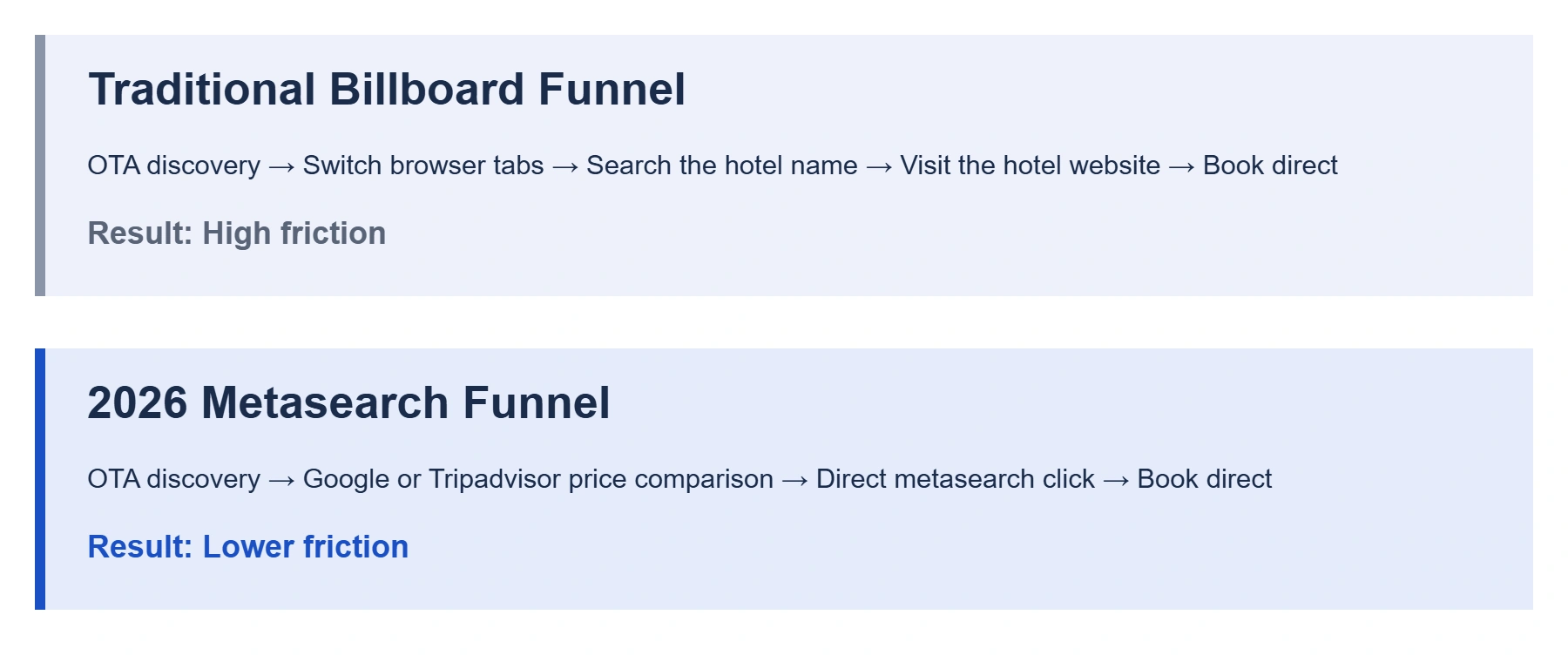
The strategic difference is substantial.
The traditional funnel requires the traveller to create the direct-booking journey independently. The metasearch funnel places the hotel’s direct rate and booking link inside the comparison process the traveller is already using.
It is not simply a shorter funnel. It is a better-timed intervention.
From PPC to Pay per Stay
Google has sunset its native commission-based Hotel Ads bidding models, including its former pay-per-stay option.
However, the commercial model itself has not disappeared.
Third-party hotel marketing and metasearch providers continue to offer performance-based arrangements under which hotels pay a commission after a completed stay rather than paying for every advertising click.
The 2026 strategy is therefore not to select Google’s former pay-per-stay model. It is to evaluate third-party PPS agreements against directly managed PPC campaigns.
Under PPC, or pay per click, the hotel carries the advertising risk. It pays when a traveller clicks, regardless of whether that visitor books, cancels or ultimately converts through another channel.
Under PPS, or pay per stay, the provider carries more of the media and conversion risk. The hotel pays an agreed commission after the guest completes the stay.
A PPS agreement charging approximately 10% to 12% of completed stay revenue can compare favourably with an OTA booking carrying a 15-20%+ commission. However, the headline commission percentage does not tell the full story.
Hotels must examine:
- Attribution rules
- Cancellation treatment
- Technology fees
- Tax treatment
- Payment charges
- Campaign coverage
- Booking-window restrictions
- Whether the provider claims bookings that would have arrived directly anyway
A 12% “direct” booking is not automatically more profitable than a 15% OTA booking if the metasearch provider receives commission for demand the hotel would have converted without paid support.
Conversely, a well-controlled PPS model can reduce financial risk for hotels that lack the budget, data volume or specialist expertise to manage PPC bidding efficiently.
The correct comparison is not PPC versus PPS in isolation. It is the total acquisition cost and incremental value of each booking.
Metasearch Rate Pluses
Price is only one component of the direct-booking proposition.
Metasearch advertising allows hotels to highlight direct-booking benefits alongside the rate comparison. This gives the hotel an opportunity to communicate value before the traveller reaches the booking engine.
Examples include:
- Free breakfast when booking direct
- Complimentary late checkout
- Flexible cancellation
- Free parking
- A welcome drink
- Priority room upgrades, subject to availability
The strongest perks combine high perceived guest value with a relatively low marginal cost for the hotel.
Breakfast may influence the booking decision more effectively than a small discount. Late checkout can improve the guest’s perception of value without permanently reducing average daily rate. Flexible cancellation may outperform a slightly cheaper but restrictive OTA offer.
The benefit must be specific.
“Best value guaranteed” is generic and difficult to substantiate.
“Book direct and receive free breakfast plus late checkout” gives the traveller a concrete reason to select the official website.
Rate competitiveness remains essential.
A direct offer that is materially more expensive will rarely be rescued by vague perks.
When the prices are equal or close, however, a clearly merchandised benefit can change the comparison from “Which room is cheaper?” to “Which booking gives me more value?”
Uncover the hidden revenue potential
of your hotel or resort.
3. Instant-Gratification Loyalty Incentives
Independent hotels should question whether traditional points-based loyalty programmes match their actual guest behaviour.
That does not mean loyalty is irrelevant. It means the mechanism must reflect the frequency and purchasing patterns of the hotel’s guests.
A traveller who visits a destination once every few years has little incentive to collect points linked to a single independent property. A complicated earn-and-redeem structure creates administrative work without creating meaningful motivation.
Independent hotels should not copy the loyalty mechanics of a global hotel chain without possessing the frequency, portfolio and redemption network of a global brand.
Closed-User-Group Instant Rewards
A closed-user-group model replaces delayed value with an immediate benefit.
Instead of promising points that may become useful after several future stays, the hotel provides an immediate reward as soon as the traveller becomes an eligible member.
The proposition is simple:
Join now. Save now. Book now.
The reward may include:
- A private member rate
- Free breakfast
- Flexible cancellation
- Complimentary parking
- A room upgrade
- A combination of price and experience-based benefits
The objective is not to create the appearance of a loyalty programme. It is to give travellers an immediate economic reason to move from an OTA to the direct booking engine.
The hotel also gains the opportunity to capture first-party guest data, receive marketing consent and establish a direct relationship before arrival.
A booking engine could display a callout such as:
“Unlock 10% off instantly by logging in with Google or Facebook.”
Social login can reduce registration friction because travellers do not need to create and remember another password. The private member offer becomes visible after authentication.
However, a social login does not automatically make a rate exempt from every rate-parity obligation.
The definition of a valid closed user group depends on the hotel’s OTA agreements and the legislation applicable in its market. Requirements can include active opt-in, password protection, a completed customer profile or previous transaction history.
Hotels should therefore avoid treating a login wall as a universal legal loophole.
The operational principle remains valid: authenticated, non-public offers can create a direct-booking advantage where the hotel’s contracts and local regulations permit them.
The setup must be deliberate. A public discount placed behind a superficial pop-up is not a credible closed-user-group strategy. The hotel should clearly define membership, record consent, protect access and confirm that the offer complies with its commercial agreements.
The strongest closed-user-group strategies do more than reduce the room rate. They segment the direct-booking proposition.
A price-sensitive traveller may respond to an immediate discount. A higher-value guest may prefer breakfast, parking, flexible cancellation or priority for room upgrades.
Hotels should test which benefit increases direct conversion while preserving the highest possible Net RevPAR.
The objective is not to maximise direct-booking volume at any cost. It is to support the wider goal of maximising hotel profit through more profitable direct demand.
4. Protecting the Bottom Line
The Billboard Effect is no longer a passive traffic generator. It is a distribution battleground.
OTAs still create valuable exposure. Rejecting them entirely would be strategically naive for most independent hotels.
The problem is not OTA participation. It is unmanaged OTA dependence.
As a revenue management consulting firm, we know that as current hotel revenue management trends continue to reshape pricing and distribution, independent hotels must optimise the digital infrastructure surrounding that demand. Metasearch should operate as a distribution defence mechanism, placing the hotel’s official rate and value proposition inside the comparison environment.
The direct booking engine should operate as an instant-value engine, converting travellers through speed, clarity, relevant benefits and controlled membership incentives.
Every channel should be judged according to the same commercial questions:
- What demand did the channel generate?
- What did that demand cost?
- Would the booking have occurred without the channel?
- How much Net RevPAR remained after all acquisition costs?
- Did the booking strengthen or weaken the hotel’s long-term distribution position?
That is the real direct-booking playbook.
The strategic question is not simply “OTA or direct?” It is how the hotel can build a more profitable distribution mix while retaining greater control over guest acquisition, pricing and customer data.
Cheers,
Remko West
PS. Any doubts or uncertainties about how to tackle next year? Contact us for our revenue management consulting or hotel consulting services to help build a solid plan to outperform your competition.

More Free Resources
Top 10 Popular Posts
Share This Story, Choose Your Platform!

About the Author:
As COO and Co-Founder of XOTELS, Remko West has made it his mission to turn hotels and resorts into local market leaders. XOTELS´ diverse expertise and deep-knowledge across revenue management consulting, hotel management, and hotel consulting, enables us to drive results for independent boutique hotels, luxury resorts, and innovative lodging concepts.